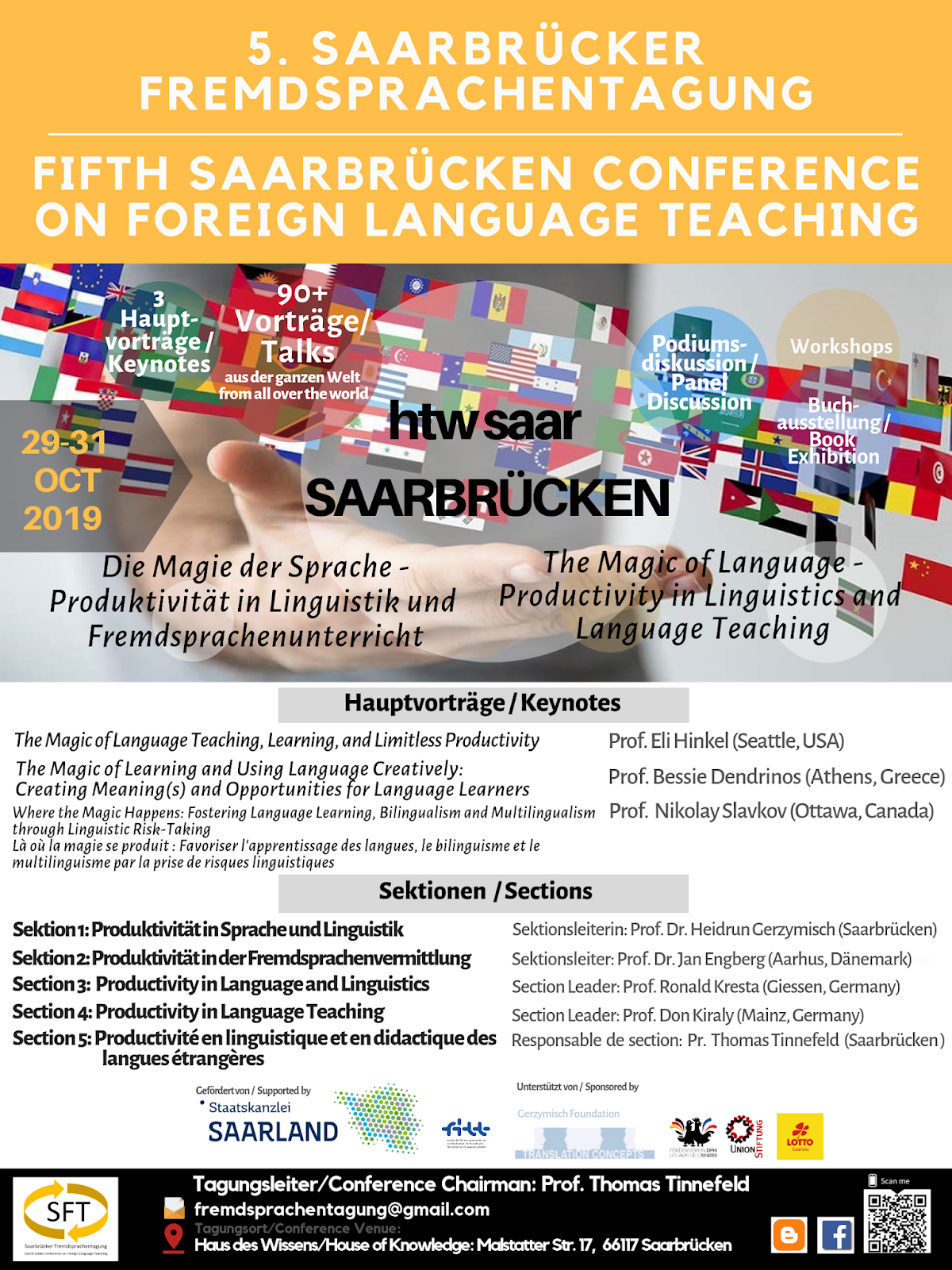
Registration is open from now on until 31 August 2019 (for talk presentation) and 30 September 2019 (for mere participation), respectively.

Please send an e-mail to

fremdsprachentagung@googlemail.com


Conference fee (inclusive of VAT): 
  • Presenters and participants: 60,- € (for three days)
  • Students: 30,- € (for three days)
  • Day ticket (not for presenters): 25,- €
For our foreign participants' convenience, the conference fee can be paid in cash (euros) on arrival at the conference office. A bank transfer in the run-up to the conference is not provided. 

The conference fee includes:
  • participation in the reception on the first day
  • the evening buffet on the second day
  • light lunch on all the three conference days
  • coffee and cake offered during the numerous breaks
  • the conference bag and the conference folder
Conference Chairman: Professor Thomas Tinnefeld


The Magic of Language Teaching, Learning, and Limitless Productivity

Abstract and Biodata


The Magic of Learning and Using Language Creatively:
Creating Meaning(s) and Opportunities for Language Learners

Abstract and Biodata


Where the Magic Happens: Fostering Language Learning, Bilingualism and Multilingualism through Linguistic Risk-Taking

Là où la magie se produit : Favoriser l'apprentissage des langues, le bilinguisme et le multilinguisme par la prise de risques linguistiques

Bilingual Presentation (English / French)


The Magic of Learning and Using Language Creatively:
Creating Meaning(s) and Opportunities for Language Learners


Abstract 


In using semiotic modes of communication (written, oral, visual, audio, tactile, gestural, spatial), often in combination so as to produce multimodal texts, people create meanings. This is to say that meaning is not inherent in a word, a sentence or a larger chunk of speech or writing. Meanings are created and interpreted by users, they are created both at the level of comprehension and production. More often than not, the ultimate aim is to transmit or rather mediate these meanings to others or for the sake of others, who will, in turn, try to make sense of what they hear and see by creating their own meanings. The need to develop the ability to perform social practices in meaningful ways in order to contribute to successful communication and understanding is crucial in today’s information societies, which are technology-enhanced and inhabited in both the digital and the ‘real’ world by culturally and linguistically diverse populations.

However, curricula, curriculum artifacts and pedagogical practices in (foreign) language classrooms are still sterilized, impoverished environments oriented to providing monolingual literacy to students, viewed as social subjects obliged to acquire linguistic skills in order to produce speech and writing that is lexically and grammatically accurate, and to reproduce the meanings articulated by others. Language pedagogy, saturated with ideological constructs, continues to be inspired by linguistic theory that focuses on the ‘ideal speaker-listener’ in a homogeneous speech-community, who knows the language perfectly, is unaffected by conditions of speech comprehension or production and who can speak or write the language (as though it were a single unit) – thus appropriating a system of norms regulating social practices.

The aim of my talk is to argue that we do not need supernatural powers to change the long-established ways of understanding what language is, how it is taught and learnt. But we may need some magic to change our way of thinking about language and language education: to see the language classroom as a multilingual social and pedagogical space that provides opportunities to learners to be cultivated as multilingual meaning-makers rather than as “talking heads” acquiring forms and skills (Kramsch 2009: 28); a space where learners are actively engaged as knowledge producers and creators of their own meanings, using a Learning-by-Design pedagogy of multiliteracies, examples of which will be demonstrated. The L-by-D pedagogy represents an inclusive approach to learner diversity, by “building into curriculum the idea that not every learner will bring the same life-world experiences and interests to learning, and creating pedagogical scaffolds which do not assume that every learner has to be on the same page at the same time” (Cope & Kalantzis 2015). Our students can then begin to discover the magic of learning and using language.  


Die Magie des Lernens und sprachliche Kreativität 

Menschen schaffen Bedeutungen durch die Verwendung semiotischer Kommunikationsmodi (geschrieben, mündlich, visuell, audio, taktil, gestisch, räumlich) - oft in Kombination -, um multimodale Texte zu produzieren. Das heißt, dass die Bedeutung nicht in einem Wort, einem Satz oder einem größeren Teil der Sprache oder des Schreibens enthalten ist. Bedeutungen werden von den Nutzern erstellt und interpretiert; sie werden sowohl auf der Ebene des Verständnisses als auch auf der Ebene der Produktion geschaffen. Meist geht es darum, diese Bedeutungen anderen zu vermitteln, die wiederum versuchen werden, das, was sie hören und sehen, durch die Schaffung ihrer eigenen Bedeutungen zu verstehen. Die Notwendigkeit, die Fähigkeit zu entwickeln, sozial in sinnvoller Weise zu agieren, um zu einer erfolgreichen Kommunikation und Verständigung beizutragen, ist in den heutigen, technologisch angereicherten und sowohl in der digitalen als auch in der "realen" Welt von kulturell und sprachlich unterschiedlichen Bevölkerungsgruppen bewohnten Informationsgesellschaften von entscheidender Bedeutung

Allerdings sind Lehrpläne, Lehrplanartefakte und pädagogische Praktiken in (Fremd-)Sprachräumen immer noch sterile, gleichsam verarmte Umgebungen, die darauf ausgerichtet sind, den Schülern eine monolinguale Kompetenz zu vermitteln. Diese werden dabei als soziale Wesen angesehen, die dazu verpflichtet sind, Sprachkenntnisse zu erwerben, um lexikalisch und grammatikalisch korrekte Sprache und Schrift zu produzieren und die von anderen formulierten Bedeutungen zu reproduzieren. Die mit ideologischen Konstrukten gesättigte Sprachpädagogik ist nach wie vor von der Sprachtheorie inspiriert, die sich auf den "idealen Sprecher-Hörer" in einer homogenen Sprachgemeinschaft konzentriert - der die Sprache perfekt kennt, von den Bedingungen des Sprachverständnisses oder der Sprachproduktion unbeeinflusst ist und die Sprache sprechen oder schreiben kann (als wäre es eine einzige Einheit) - und sich so ein Normensystem aneignet, das die sozialen Praktiken regelt.

Das Ziel meines Vortrags ist es, zu argumentieren, dass wir keine übernatürlichen Kräfte brauchen, um die seit langem etablierten Methoden zu ändern und um zu verstehen, was Sprache ist, wie sie gelehrt und gelernt wird. Aber wir brauchen vielleicht etwas Magie, um unsere Denkweise über Sprache und Sprachunterricht zu ändern: den Sprachunterricht als einen mehrsprachigen sozialen und pädagogischen Raum zu sehen, der den Lernenden die Möglichkeit bietet, als mehrsprachige Erschaffer von Bedeutung - und nicht als "sprechende Köpfe" -, die Formen und Fähigkeiten erwerben, kultiviert zu werden (Kramsch 2009: 28); einen Raum, in dem die Lernenden aktiv als Wissensproduzenten und Schöpfer ihrer eigenen Bedeutungen tätig sind, mit einer Learning-by-Design-Pädagogik multilingualer Bildung, für die Beispiele gezeigt werden. Die L-by-D-Pädagogik stellt einen integrativen Ansatz für die Vielfalt der Lernenden dar, indem sie die Idee, dass nicht jeder Lernende die gleichen Erfahrungen und Interessen in die Lebenswelt einbringt, in den Lehrplan integriert und pädagogische Gerüste schafft, die nicht davon ausgehen, dass jeder Lernende zur gleichen Zeit auf der gleichen Lehrbuchseite sein muss (Cope & Kalantzis 2015). Unsere Schüler können dann beginnen, die Magie des Lernens und des Umgangs mit der Sprache zu entdecken.


Biodata

Bessie Dendrinos is Professor Emerita of the Department of Language and Linguistics, Faculty of English, at the National and Kapodistrian University of Athens in Greece, and Director of the Research Centre of Language Teaching and Assessment (www.rcel.enl.uoa.gr). Involved in socially accountable applied linguistics, she has critiqued the discursive practices of ELT and European educational language policies. Her areas of expertise are language politics in the European Union and foreign language pedagogy, especially curriculum and materials development, language testing and assessment, translanguaging and cross-linguistic mediation. Since 2002, she has devoted much of her time to developing and operationalizing a multilingual examination suite, of which she is president of the board. The exams for six languages, on the 6-level scale of the Council of Europe, are prepared by expert teams at the Kapodistiran University of Athens and the Aristotle University of Thessaloniki. Known as the ‘KPG exams’ (http://rcel2.enl.uoa.gr/kpg), they are conducted by the Ministry of Education, which issues the certificates of language proficiency. In recent years, she directed two multidimensional national projects for the reform of the foreign languages curriculum and the introduction of the first foreign language from the first year of elementary school. Since 2014, she is president of the European Civil Society Platform for Multilingualism (www.ecspm.org). 


The Magic of Language Teaching, Learning, and Limitless Productivity


Abstract

Learning to understand and produce spoken or written language means being able to understand how language components combine and interact to produce meaning and discourse.  To communicate in a foreign language (FL), learners need to become skilled users of grammar, vocabulary, and pragmatic constructions that are contextually-suitable and relatively idiomatic.  Speaking and writing in a language other than one's mother tongue requires an extraordinary range of communicative skills in a myriad of functional contexts.  And then in addition to being able to deploy a foreign language appropriately and in context, FL users need to be able to comprehend what is said and grasp a speaker's purpose.  If the interactional function is not identified correctly, then the communicative goal of an interaction may not be achieved.  To these ends, learners need to build their linguistic repertoire in order to participate in spoken and written communications, formal and casual alike (Hinkel, 2015, 2017, 2019; Nation, 2013, 2017).  Developing productive language abilities for conveying and understanding ideas in another language is nothing short of magical in the way that it opens doors, creates opportunities, and makes connections possible.

Speaking and writing require engaging in complex cognitive and linguistic tasks.  Both spoken exchanges and written discourse are highly structured and progress along predictable and culturally-determined patterns, with participants adapting, adjusting and readjusting, and tailoring what they are saying -- or going to say -- depending on the social setting and communicative objectives.  Effective and fluent language production, spoken or written, has to remain reasonably grammatically and lexically intelligible, culturally structured and organized (e.g. turn-taking), cohesive, well-paced (e.g. openings, introductions, and closings), socially and contextually pertinent, and appropriately worded, e.g. politeness (Carter & McCarthy, 2006). 

For most learners, a reasonable stock of vocabulary and a degree of grammatical proficiency is crucial for productive and successful language uses.  In both speech and writing, discourse and idiomatic sequences can be utilized with an astounding number of functions in a virtually unlimited array of communicative and social purposes.  This presentation offers highly practical suggestions for teaching vocabulary and grammar that seek to be constructive and down-to-earth, that is, how to perform the magic of language teaching and learning expeditiously.  These suggestions target specific language to maximize language gains by employing a few shortcuts.  Spoken and academic vocabulary, grammar structures, and stock multiword phrases can be learned and practiced in the context of writing, vocabulary, or grammar instruction at practically any level of student proficiency.  This approach focuses on state-of-the art developments in second language pedagogy in speaking, contextualized vocabulary learning, grammar, and reading.  


Die Magie des (Fremdsprachen)Lernens und grenzenloser Produktivität

Die Fähigkeit zu lernen, gesprochene oder geschriebene Sprache zu verstehen und zu produzieren, bedeutet zu verstehen, wie sprachliche Komponenten sich miteinander kombinieren lassen und miteinander interagieren, um Bedeutung und Diskurs zu erzeugen. Um in einer Fremdsprache (FL) zu kommunizieren, müssen die Lernenden zu erfahrenen Nutzern von Grammatik, Wortschatz und pragmatischen Konstruktionen werden, welche kontextgerecht und relativ idiomatisch sind. Das Sprechen und Schreiben in einer anderen Sprache als der Muttersprache erfordert eine außergewöhnliche Bandbreite an kommunikativen Fähigkeiten in einer Vielzahl von funktionalen Kontexten. Und dann müssen FL-Anwender nicht nur eine Fremdsprache richtig und im Kontext einsetzen können, sondern auch in der Lage sein, das Gesagte zu verstehen und den Zweck eines Sprechers zu erfassen. Wenn die interaktionale Funktion nicht korrekt identifiziert wird, kann es sein, dass das kommunikative Ziel einer Interaktion nicht erreicht wird. Zu diesem Zweck müssen die Lernenden ihr sprachliches Repertoire aufbauen, um an mündlichen und schriftlichen Kommunikationen teilzunehmen - sowohl formell als auch informell (Hinkel, 2015, 2017, 2019; Nation, 2013, 2017). Die Entwicklung produktiver Sprachfähigkeiten für die Vermittlung und das Verständnis von Ideen in einer anderen Sprache ist geradezu magisch, da sie Türen öffnet, Chancen schafft und Verbindungen ermöglicht.

Sprechen und Schreiben erfordern die Beschäftigung mit komplexen kognitiven und sprachlichen Aufgaben. Sowohl der gesprochene Austausch als auch der schriftliche Diskurs sind stark strukturiert und verlaufen nach vorhersehbaren und kulturell bedingten Mustern ab, wobei die Teilnehmer das, was sie sagen - oder sagen werden - je nach sozialem Umfeld und kommunikativen Zielen anpassen, nachbessern, erneut nachbessern und schließlich gleichsam passend zuschneiden. Effektive und fließende Sprachproduktion - ob in Wort oder Schrift - muss grammatisch möglichst korrekt und lexikalisch verständlich, kulturell strukturiert und organisiert, kohärent, gut durchdacht und sozial sowie kontextbezogen angemessen formuliert werden (Carter & McCarthy, 2006).

Für die meisten Lernenden sind ein angemessener Wortschatz und ein gewisses Maß an Grammatikkenntnissen entscheidend für einen produktiven und erfolgreichen Sprachgebrauch. Sowohl in Wort und Schrift können Diskurs und idiomatische Abläufe mit einer erstaunlichen Anzahl von Funktionen in einer nahezu unbegrenzten Anzahl von kommunikativen und sozialen Zwecken genutzt werden. Dieser Vortrag bietet praktische und konstruktive Vorschläge für den Vokabel- und Grammatikunterricht und widmet sich nicht zuletzt der Frage, wie die Magie des Sprachunterrichts und des Sprachenlernens funktional eingesetzt werden kann. Diese Vorschläge zielen auf eine Maximierung des Sprachlernerfolgs durch Verwendung entsprechender didaktischer Abkürzungen ab. Gesprochenes und akademisches Vokabular, Grammatikstrukturen und Mehrwortphrasen können im Rahmen des Schreib-, Wortschatz- und Grammatikunterrichts auf praktisch jedem Niveau erlernt und geübt werden. Dieser Ansatz konzentriert sich auf die neuesten Entwicklungen in der Zweitsprachendidaktik zum Sprechen, zum kontextualisierten Wortschatzlernen, zur Grammatik und zum Lesen.


Biodata 

Professor Eli Hinkel has taught ESL and applied linguistics, as well as trained teachers, for over thirty years and has published numerous books and articles on learning second culture, and second language grammar, writing, and pragmatics in such journals as TESOL Quarterly, Applied Linguistics, Journal of Pragmatics, and Applied Language Learning. She is also the editor of the Routledge ESL & Applied Linguistics Professional Series of books and textbooks for teachers and graduate students.


Bitte beachten: Länge der Sektionsvorträge: 30 Minuten plus 10 Minuten für die Diskussion.

Please note: Duration of the section talks: 30 minutes plus 10 minutes for the Q&A session.

Nota bene: Longueur des conférences présentées dans les différentes sections: 30 minutes plus 10 minutes pour les questions-réponses.

Sektion 1: Produktivität in Sprache und Linguistik

Vorträge (in alphabetischer Reihenfolge):


Der Zauber der Sprache: Wie Literatur und Linguistik  zusammenfließen - am Beispiel von ‚das Wunderbare‘ in Ibsens Nora oder Ein Puppenheim (Abstract)

Wenn aus Wörtern Bilder werden: Die zauberhafte Sprache der Audiodeskription (Abstract)

Architecture and Language: Visualizing the Magic of Linguistic Creation (Abstract)

Die Frankreichstrategie des Saarlandes: Ist Finnland ein Vorbild? (Abstract)

A Comparative Study of Conceptual Love Metaphors in German, English and Chinese (Abstract)

Procédés d’écriture hybride dans Temps de chien de Patrice Nganang : de l’appropriation du français à la créativité linguistique (Abstract)

Wörter, Texte, Sinn: Was wird gedolmetscht  – und was nicht? (Abstract)

Ich seh dir in die Augen, Kleines oder: Was heißt kreatives Übersetzen? (Abstract)

Kreativität im Blog – Beispielanalyse eines Blogposts aus dem Blog Read on my dear, read on (Abstract)

PD Dr. Abdel-Hafiez Massud (Karlsruhe):
Zur Polysemie des Kopftuches im deutschsprachigen Diskurs – Eine frame-semantische Analyse (Abstract) (Vortrag kurzfristig abgesagt)

Zu modernen lexikalischen Tendenzen im Deutschen und Arabischen - eine kontrastive Untersuchung zur Sprache der Werbung (Abstract) (Vortragende nicht erschienen)

Prof. Dr. Marion Weerning (Palermo, Italien):
Zauberwörter der deutschen Sprache: Modalpartikeln (Abstract)

Dr. Ryuko Woirgardt (Saarbrücken):
Die Magie japanischer Lexik (Abstract)