
Posts mit dem Label 1 English werden angezeigt. Alle Posts anzeigen
Posts mit dem Label 1 English werden angezeigt. Alle Posts anzeigen

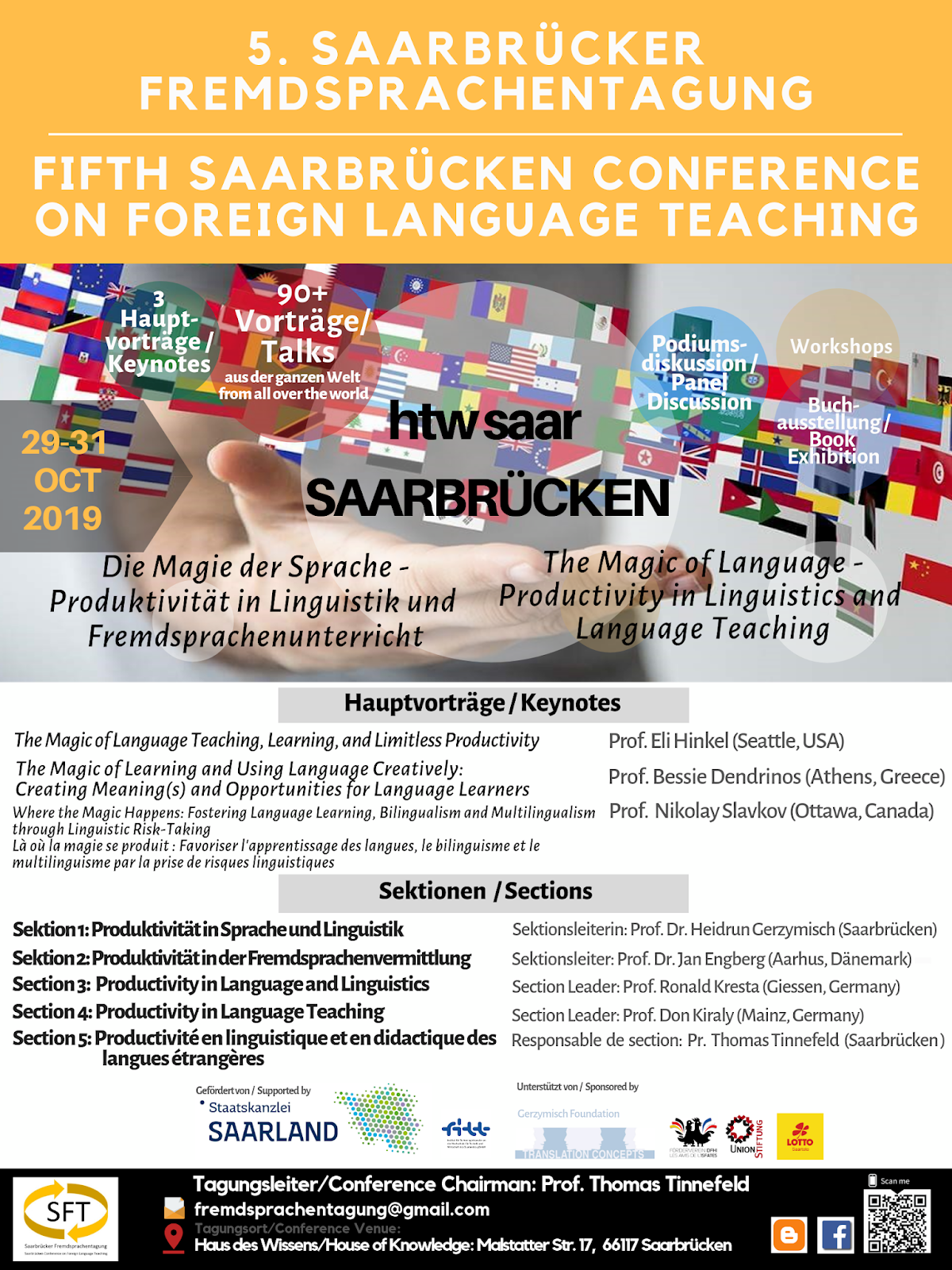
Fifth Saarbrücken Conference on Foreign Language Teaching
The Magic of Language -
Productivity in Linguistics and Language Teaching
29-31 October 2019
The theme of the Fifth Saarbrücken Conference on Foreign
Language Teaching is productivity in linguistics and language teaching, the
productive use of language often being marked by an undeniable magic. This
magic does not only consist in the fact that people are capable of
understanding each other, provided that they master the same code. It is also
true when people talk about things they have never talked about and when new
ideas occur to them or when they use notions and words that have not existed
before, i.e. when they employ language productively and construct their own
world. The relationship between the productivity and the magic of language
works on various levels.
Productivity works on the level of pragmatics. Whenever people
produce sentences and utterances, they are productive. The linguistic means
that they have at their disposal allow them to create language structures and
language patterns which aim at communicating information, arousing emotions
and, eventually, eliciting reactions in their interlocutors.
Productivity also works on the level of languages for specific
purposes. Any newly discovered phenomenon of the extralinguistic world will
need to be named and classified. Neologisms, which provide a linguistic form
for the corresponding notions, function at the word level and are often times
of a specific nature. These languages for specific purposes, then, are
productive sublanguages par excellence.
Whereas in the previous examples, the productivity of language
refers to linguistics, it is equally present in the realm of language
methodology. Whenever teachers instruct their pupils and students to
communicate orally or in writing, they boost the latter's productivity.
Teachers enable students to overcome boundaries in a language other than their
mother tongue and, thus, to enter a terra incognita, which may give them a
feeling for their own intellectual potential on the one hand, and a certain
awareness of their chances to enter in contact with other people, who they
would not have been able to communicate with if they did not master the target
language. This aspect also stands for the magic of language as we understand it
here.
The magic of language also refers to the interpersonal and
intercultural mechanisms which are characteristic of any communication
situation. In situations like critical incidents, for example, boundaries,
which generally exist between individuals and also between people of different
cultural imprints and socialisations, will be overcome. The processes involved
will then lead to a redefinition of such relationships and, thus, be
productive.
The processes going on in the brains of bilingual and
multilingual people are different from those going on in the brains of
monolingual people. Therefore, the brains of bilingual and multilingual people
develop into structures that are different from the ones of monolingual people.
It is clear, then, that productivity has a direct influence on the mental and
intellectual development of human beings and their personalities. However,
there also exist emotional factors that come into play.
We all may have found that we are “different” in situations when
we are speaking a foreign language as compared to those situations in which we
are using our mother tongue. Acting multilingually, we seem to have different
personalities – one for each language we speak. The fact that speaking or
writing in different languages makes us feel different may be exemplified by
the question of how easy or how difficult it is to make emotionally charged
utterances – e.g., a sentence like I love you – in our native language. When
giving it a thought, we will soon notice that it is much easier to make such
utterances in a foreign language than in our mother tongue, as in the foreign
language, our emotions are redefined and we feel freer in terms of behaviour
and use of language.
These
few reflections illustrate the fact that language in general and the teaching
and learning of foreign languages in particular generally provide us with new
insights. This is true for various areas of linguistics as well as for our
daily and professional lives and, last but not least, for language methodology.
The magic of language, which is closely intertwined with the productivity of
language, is the theme of the Fifth Saarbrücken Conference on Foreign Language
Teaching. This theme surely is less accessible, less "handy", than
other potential themes, but it surely is one that allows creativity to happen
and that may generate multiple stimuli for the professional practice of
teachers and researchers.
Aiming to provide a platform to bring scholars and researchers
together for mutual inspiration and idea exchange, we hope we will have the pleasure of your participation in our fifth conference in 2019.
Deadline of abstract submission in until 31
August 2019 by email
to
fremdsprachentagung@googlemail.com
The duration of the section talks will be 30 minutes plus 10 minutes for the Q&A session.
As the number of time slots available for talks is limited, it is highly recommended that abstracts be submitted in good time.

Registration is open from now on until 31 August 2019 (for talk presentation) and 30 September 2019 (for mere participation), respectively.
Please send an e-mail to
fremdsprachentagung@googlemail.com
Conference fee (inclusive of VAT):
- Presenters and participants: 60,- € (for three days)
- Students: 30,- € (for three days)
- Day ticket (not for presenters): 25,- €
For our foreign participants' convenience, the conference fee can be paid in cash (euros) on arrival at the conference office. A bank transfer in the run-up to the conference is not provided.
The conference fee includes:
- participation in the reception on the first day
- the evening buffet on the second day
- light lunch on all the three conference days
- coffee and cake offered during the numerous breaks
- the conference bag and the conference folder
Conference Chairman: Professor Thomas Tinnefeld


The Magic of Learning and Using Language Creatively:
Creating Meaning(s) and Opportunities for Language Learners
Abstract and Biodata
Creating Meaning(s) and Opportunities for Language Learners
Abstract and Biodata

Where the Magic Happens: Fostering Language Learning,
Bilingualism and Multilingualism through Linguistic Risk-Taking
Là où la magie se
produit : Favoriser l'apprentissage des langues, le bilinguisme et le
multilinguisme par la prise de risques linguistiques
Bilingual
Presentation (English / French)
Bitte beachten: Länge der Sektionsvorträge: 30 Minuten plus 10 Minuten für die Diskussion.
Please note: Duration of the section talks: 30 minutes plus 10 minutes for the Q&A session.
Nota bene: Longueur des conférences présentées dans les différentes sections: 30 minutes plus 10 minutes pour les questions-réponses.
Section 3: Productivity in Language and Linguistics

Section Leader: Professor Ronald Kresta (Giessen, Germany)
Talks (in alphabetical order):
Sara El-Sayed Ibrahim (Alexandria, Egypt):
Professor Johannes Brinkmann, Professor Beate Lindemann & Professor Hans Jörg Schlierer (Tromsø, Norway):
Publish in English or Perish - Language Discrimination Risks in Academia (e.g. Business Ethics) (Abstract)
Sara El-Sayed Ibrahim (Alexandria, Egypt):
Problematizing Language: The Native Speaker and Deleuze (Abstract)
Professor Irina Gvelesiani (Tbilisi, Georgia):
New Applications in Modeling Bilingualism Via Fractional Dynamics (Abstract)
Insights from the Royal Society Corpus on English Academic Writing (Abstract)
Professor Jozsef Szakos (Taipei, Taiwan):
Innovation and Productivity in the Transmission of Indigenous Languages of Taiwan (Abstract)
Professor Brikena Xhaferi (Tetovo, Republic of North Macedonia):
Disagreement Strategies in Albanian and English – A Contrastive Analysis (Abstract)
Section 4: Productivity in Language Teaching
Section Leader: Professor Don Kiraly (Mainz, Germany)
Talks (in alphabetical order):
Is it Magic, Child’s Play or Perhaps… Complexity?: A Post-Teaching Approach to Additional Language Emergence in Adults (Abstract) (Talk cancelled)
Dr. Heidi Altmann & Professor Sabine Zerbian (Stuttgart, Germany):
Persistent Accentual Features of German Pre-Service EFL Teachers (Abstract)
Professor Sandro R. Barros (East Lansing (MI), USA):
The Magic of Training Foreign Language Educators (Abstract)
Professor Joara Martin Bergsleithner (Brasília, Brazil):
Cognitive Aspects and Instruction in L2 Oral Productivity (Abstract)
Dr. Adcharawan Buripakdi (Nakorn Ratchasima, Thailand):
Disturbing the Conventional Discourse in English Education: Asian Perspectives (Abstract)
Professor Anna Burnley (Tallahassee, Florida, USA):
An Exploration of Pre-Service Teachers’ Measures of Emotional Resilience and Flexibility / Openness toward English Learners (Abstract)
Professor Sandro R. Barros (East Lansing (MI), USA):
The Magic of Training Foreign Language Educators (Abstract)
Professor Joara Martin Bergsleithner (Brasília, Brazil):
Cognitive Aspects and Instruction in L2 Oral Productivity (Abstract)
Dr. Adcharawan Buripakdi (Nakorn Ratchasima, Thailand):
Disturbing the Conventional Discourse in English Education: Asian Perspectives (Abstract)
Professor Anna Burnley (Tallahassee, Florida, USA):
An Exploration of Pre-Service Teachers’ Measures of Emotional Resilience and Flexibility / Openness toward English Learners (Abstract)
The Big Five Personality Factors as Predictors of English Language Reading Anxiety: a Comparative Study on Moroccan and Korean EFL learners (Abstract) (Last-minute cancellation)
Dr. Rudi Camerer (Frankfurt / Saarbrücken, Germany):
Introducing the new CEFR-Companion Volume (CEFR-CV) (Abstract)
Dr. Rudi Camerer (Frankfurt / Saarbrücken, Germany):
Introducing the new CEFR-Companion Volume (CEFR-CV) (Abstract)
Greek-Cypriot
Learners’ Knowledge of Phrasal Verbs (Abstract)
Professor Olga Dobrunoff (West Point, USA):
Modality in Russian and Development of Students' Cultural and Pragmatic Competence (Abstract)
Professor Martin East (Auckland, New Zealand):
Professor Olga Dobrunoff (West Point, USA):
Modality in Russian and Development of Students' Cultural and Pragmatic Competence (Abstract)
Professor Martin East (Auckland, New Zealand):
Enhancing Foreign Language Students’ Spoken Proficiency through a new Classroom-Based Assessment Model. A Case Study (Abstract)
Adapting Teaching to Learning Styles in Primary Education (Abstract)
Dr. Alexander Gerashchenko & Professor Tatiana Shaposhnikova (Krasnodar, Russia):
A Course of English for Teachers within the International Mobility Project at a Russian Technological University (Abstract)
Dr. Alexander Gerashchenko & Professor Tatiana Shaposhnikova (Krasnodar, Russia):
A Course of English for Teachers within the International Mobility Project at a Russian Technological University (Abstract)
Dr. Cornelia Gerhardt, Dr. Verena Bernardi, Daniel Honert & Dr. Henry Rademacher (Saarbrücken, Germany):
Teaching (How to Teach) Vocabulary: A Moodle-Based Blended Learning Class at University Level Focusing on Learning Styles (Abstract) (Last-minute cancellation)
Incidental Focus on Form Revisited through the Lenses of Formulaic Language (Abstract) (No-show)
Norman Gomez-Hernandez (Mainz, Germany):
Norman Gomez-Hernandez (Mainz, Germany):
The Magic of Manipulation through Language: Rewriting and Ideology in Language Policies in Hispanic-American History (Abstract) (Last-minute cancellation)
Setting Up Classes for the Magic to Happen (Abstract)
Professor Noureddine Guerroudj (Sidi Bel Abbes, Algeria):
Teaching Alice Munroe’s short story Face in an EFL Context: towards an interactive approach (Abstract)
Professor Birgit Huemer, Professor Katrien Deroey & Dr. Eve Lejot (Luxemburg):
Comparing Academic Languages: German, English, French (Abstract)
Professor Hulya Ipek & Dr. G. Müge Kanatlar (Eskişehir, Turkey):
Enhancing Language Production through Speaking: The TV Project (Abstract)
Professor Noureddine Guerroudj (Sidi Bel Abbes, Algeria):
Teaching Alice Munroe’s short story Face in an EFL Context: towards an interactive approach (Abstract)
Professor Birgit Huemer, Professor Katrien Deroey & Dr. Eve Lejot (Luxemburg):
Comparing Academic Languages: German, English, French (Abstract)
Professor Hulya Ipek & Dr. G. Müge Kanatlar (Eskişehir, Turkey):
Enhancing Language Production through Speaking: The TV Project (Abstract)
Self-perceived Competence and L2 Willingness to Communicate: Findings from an Empirical Investigation (Abstract)
How Adult are Greek University Students in an English-for-Specific-Academic-Purposes Class? A Case Study (Abstract)
The Interplay between Language and Content - Building Blocks of CLIL-Enriched Innovative Language Teaching (Abstract)
Bochra Kouraichi (Szeged, Hungary):
Improving ESP Students’ Motivation towards Communicating in English (Abstract)
Bochra Kouraichi (Szeged, Hungary):
Improving ESP Students’ Motivation towards Communicating in English (Abstract)
Bewitched yes, but not for life: An empirical investigation of persistent sound-related errors by German college students in ESP classes (Abstract)
Professor Oksana Kutsa & Professor Svitlana Kravets (Ternopil, Ukraine):
Developing Emotional Intelligence in the English Language Classroom Using Technology: Challenges and Benefits (Abstract)
Chahrazad Mouhoubi-Messadh (Algiers, Algeria):
The Magic of Enjoyment in Foreign Language Productivity: Insights from Speaking and Writing Classes (Abstract) (Last-minute cancellation)
Supalak Nakhornsri (Bangkok, Thailand):
From the Classroom to the Real World: Application of Outcomes-Based Assessment in English Courses (Abstract) (No-show)
Professor Goretti Prieto Botana & Professor Andrea G. Parra (Los Angeles, USA):
Professor Oksana Kutsa & Professor Svitlana Kravets (Ternopil, Ukraine):
Developing Emotional Intelligence in the English Language Classroom Using Technology: Challenges and Benefits (Abstract)
Chahrazad Mouhoubi-Messadh (Algiers, Algeria):
The Magic of Enjoyment in Foreign Language Productivity: Insights from Speaking and Writing Classes (Abstract) (Last-minute cancellation)
Supalak Nakhornsri (Bangkok, Thailand):
From the Classroom to the Real World: Application of Outcomes-Based Assessment in English Courses (Abstract) (No-show)
Professor Goretti Prieto Botana & Professor Andrea G. Parra (Los Angeles, USA):
The Effectiveness of Short-Term Study Abroad on Complex Grammatical Items (Abstract)
Professor Alesia Prakharenka & Professor Tatyana Vaitekhovich (Minsk, Belarus):
The Heuristic Potential of Educational Pages in Social Media (Abstract)
Professor Alesia Prakharenka & Professor Tatyana Vaitekhovich (Minsk, Belarus):
The Heuristic Potential of Educational Pages in Social Media (Abstract)
Communicative Approaches and Assignment-Based Learning – A Case Study at the Language Centre of the Southeast European University (Abstract) (Last-minute cancellation)
Professor Víctor Hugo Ramírez Ramírez, Professor Verónica Rodríguez Luna & Professor Jorge Martínez Cortés (Veracruz, Mexico):
The Alchemistic Power to Transform Readers to Writers in the EFL Classroom (Abstract)
(Last-minute cancellation)
Rodrigo Rodrigues (Curitiba, Brazil):
Foreign Language Teaching in a Needy Community in Brazil (Abstract)
Professor Víctor Hugo Ramírez Ramírez, Professor Verónica Rodríguez Luna & Professor Jorge Martínez Cortés (Veracruz, Mexico):
The Alchemistic Power to Transform Readers to Writers in the EFL Classroom (Abstract)
(Last-minute cancellation)
Rodrigo Rodrigues (Curitiba, Brazil):
Foreign Language Teaching in a Needy Community in Brazil (Abstract)
Sid Ali Selama (Algiers, Algeria):
Training on Educational Technologies and its Effectiveness in Enhancing EFL Classroom Practices (Abstract)
Safia Serai (Portsmouth, United Kingdom):
An Investigation of Translanguaging in Algerian University EFL Classrooms (Abstract)
Training on Educational Technologies and its Effectiveness in Enhancing EFL Classroom Practices (Abstract)
Safia Serai (Portsmouth, United Kingdom):
An Investigation of Translanguaging in Algerian University EFL Classrooms (Abstract)
Geoff Tranter (Dortmund, Germany):
Making ESP Courses Meaningful and Profitable for University Students (Abstract)
Making ESP Courses Meaningful and Profitable for University Students (Abstract)
Pronunciation Problems of Thai EFL-Teaching Major Students (Abstract)
Dr. Melissa H. Yu & Professor Barry Lee Reynolds (Macau, China):
Developing a Language Course to Teach English for Communication to Administrative Staff in an International University (Abstract)
Workshops
The following workshops will be held on the occasion of the Fifth Saarbrücken Conference on Foreign Language Teaching:
Während der fünften Saarbrücker Fremdsprachentung werden die folgenden Workshops angeboten:
31 October 9:00-10:25
Workshop
Helping language learners to change their behaviour and not to be too authentic
31. Oktober 9.00-10.25 (cancelled)
Workshop Marvin Scherschel
Workshop Marvin Scherschel
WORDBEAT
31 October 10:30-11:55
Workshop Claire Hart
Free your inner Business English chameleon!
31. Oktober 10.30-11.55
Workshop
Workshop
Wortschatzerwerb und
Wortschatzvermittlung im DaF-Unterricht
——————————————————
Workshop
Helping language learners to change their behaviour and not to be too authenticDr. Ian McMaster

In this workshop, we will discuss the natures of “authenticity” and “self” and their relevance for (language) learning. These concepts have been investigated by philosophers as far back as Plato, and a variety of sometimes contradictory interpretations have been put forward.
What does this all mean for learners of English for the world of work? If the concepts of authenticity and self are slippery, how can we apply them to learning situations? Can we tap into our learners’ “real” self and therefore optimize the learning process, or are we constantly aiming at a moving target.
Related issues are those of language “input” and language “output”. In what sense should these be “authentic”? To what extent does the “real” world provide a model that is useful for learners?
Finally, we will reflect on the importance for teachers, trainers, coaches and learners of developing the flexibility to be able to adapt and optimize their various “selves” to different contexts.
Dr. Ian McMaster is editor-in-chief of the business communication magazine Business Spotlight (www.business-spotlight.de). The magazine is aimed at people who need to use English internationally and is published by Spotlight Verlag in Munich, Europe’s leading publisher of language-learning magazines (www.spotlight-verlag.de). Spotlight Verlag is part of the DIE ZEIT publishing Group.
Ian joined Spotlight Verlag in 1992 and was editor-in-chief of the monthly general English magazine Spotlight from 1995-2003, and from 2006-2009. He founded Business Spotlight in 2001. In 2007, Business Spotlight was awarded the title of Germany’s trade journal of the year for the category “Law, science, tax and business”. It also has a licence edition for the Czech Republic.
Ian holds the CertTEB qualification as a business English trainer and is a former coordinator of the worldwide business English teachers’ organisation, IATEFL-BESIG (https://besig.iatefl.org/). He is co-author (with Bob Dignen) of Communication for International Business and Effective International Business Communication (both HarperCollins); and English for Business: 100 Tips for Effective Communication (Spotlight Verlag, e-book).
Workshop
Die musikalische Eselsbrücke – Mit Songs aus den Charts Vokabeln lernen!
Marvin Scherschel
Müsste es nicht möglich sein, zu jeder schwierigen Vokabel einen bekannten Song aus den Charts als Eselsbrücke zu finden? Die Antwort auf diese Frage - ein Jugend-forscht-Projekt und viele Entwicklungsstunden später - besteht in WORDBEAT, der ersten Lernstreaming-Plattform, die durch eine Kombination von Vokabeln und bekannten Chartsongs ihren Nutzern ein einzigartiges Lernerlebnis ermöglicht. Dazu liefert sie zu jeder englischen Vokabel Ausschnitte aus Songtexten, in denen das entsprechende Wort vorkommt und die dazugehörige Musik als Merkhilfe. Auf diese Weise wird der Lernprozess durch die Einbettung der Vokabel in den Kontext des Liedes und die Verknüpfung des Wortes mit einem emotional auditiven Reiz in Form der Lied-Melodie unterstützt.
In diesem Workshop wird die Entwicklung des Projektes von der Schulbank, über Jugend forscht bis hin zum E-Learning-Startup aufgezeigt, es werden Einblicke in die Funktionen der Plattform gegeben und gezeigt, welche Möglichkeiten die Verknüpfung authentischer Kontexte für die Zukunft des schulischen Sprachenlernens bieten kann.
Marvin Scherschel ist Geschäftsführer der Firma WORDBEAT.
Workshop
Free your inner Business English
chameleon! Claire Hart
By necessity or design, many Business English trainers
end up teaching a wide range of different courses in different places. They may
start their day with a group of apprentices at a car manufacturer and end it
with a conversation course at a language school, after having taught a group of
university Business English students somewhere in between. The pace is usually
very fast and preparation time is often short.
In this workshop we're going to look at how Business
English trainers can rise to this challenge by adapting materials, activities
and teaching ideas to a range of contexts. This should allow them to
concentrate more on the most important people in the room -- learners -- and it
will make their life easier, too.
Claire Hart has been involved in English language training for over
ten years, while working in France, the UK, and Germany, where she is now
based. She has gained valuable experience as a teacher / instructor in
secondary and tertiary education, language schools and in-company contexts. Currently,
Claire spends most of her time developing print and digital materials for
learners of English in Germany, and around the world. She is the author of the
textbook Career Express New (Cornelsen).
Workshop
Wortschatzerwerb und
Wortschatzvermittlung im DaF-Unterricht
Dr. Albrecht Klemm
Viele Deutschlernende stehen vor der
Herausforderung, in einem kurzen Zeitraum eine große Anzahl an Wörtern und
Wendungen lernen zu müssen. Die Anwendung effektiver Strategien zum
Wortschatzerwerb ist daher unerlässlich. Ausgehend von Erkenntnissen der
Fremdsprachenerwerbsforschung diskutieren wir im Workshop Materialien und
Techniken zum Wortschatzerwerb und gehen dabei im Besonderen auf die Potenziale
von Lern-Apps ein.
Dr. Albrecht Klemm promovierte an der Universität
Leipzig über die erwerbsfördernde Wirkung schriftlicher Fehlerkorrekturen im
DaF-Unterricht. Zu seinen Forschungsinteressen zählen zudem die
Curriculumsentwicklung, der fachorientierte Sprachunterricht und Deutsch als Wissenschaftssprache.
Er arbeitet als Redakteur beim SCHUBERT-Verlag.
Abonnieren
Posts (Atom)